

Delta 8, THCA and THCP are "Synthetic Cannabinoid"...Actually, no. They are not...
Naturally Occurring Cannabinoids Explained: What They Are and How They Affect the Cannabis Experience
When shopping for cannabis, you may encounter labels featuring THC, CBD, THCA, CBG, CBN, and other abbreviations. These compounds are called cannabinoids—and they play an important role in shaping the character of a cannabis product.
The cannabis plant contains at least 125 identified cannabinoids, but only a small number have been studied extensively. Each cannabinoid interacts with the body differently, and its effects may vary according to the product’s potency, terpene profile, serving size, consumption method, and the individual using it.
Here is a closer look at the major cannabinoids you are most likely to encounter.
What Are Cannabinoids?
Cannabinoids are naturally occurring compounds produced by the cannabis plant. They interact directly or indirectly with the body’s endocannabinoid system, a network involved in regulating functions such as mood, appetite, memory, sleep, discomfort, and immune activity.
Cannabinoids do not all produce the same effects. Some are intoxicating, while others are not. Many minor cannabinoids remain in the early stages of research, so claims about their benefits should be approached carefully.
THCA: Tetrahydrocannabinolic Acid
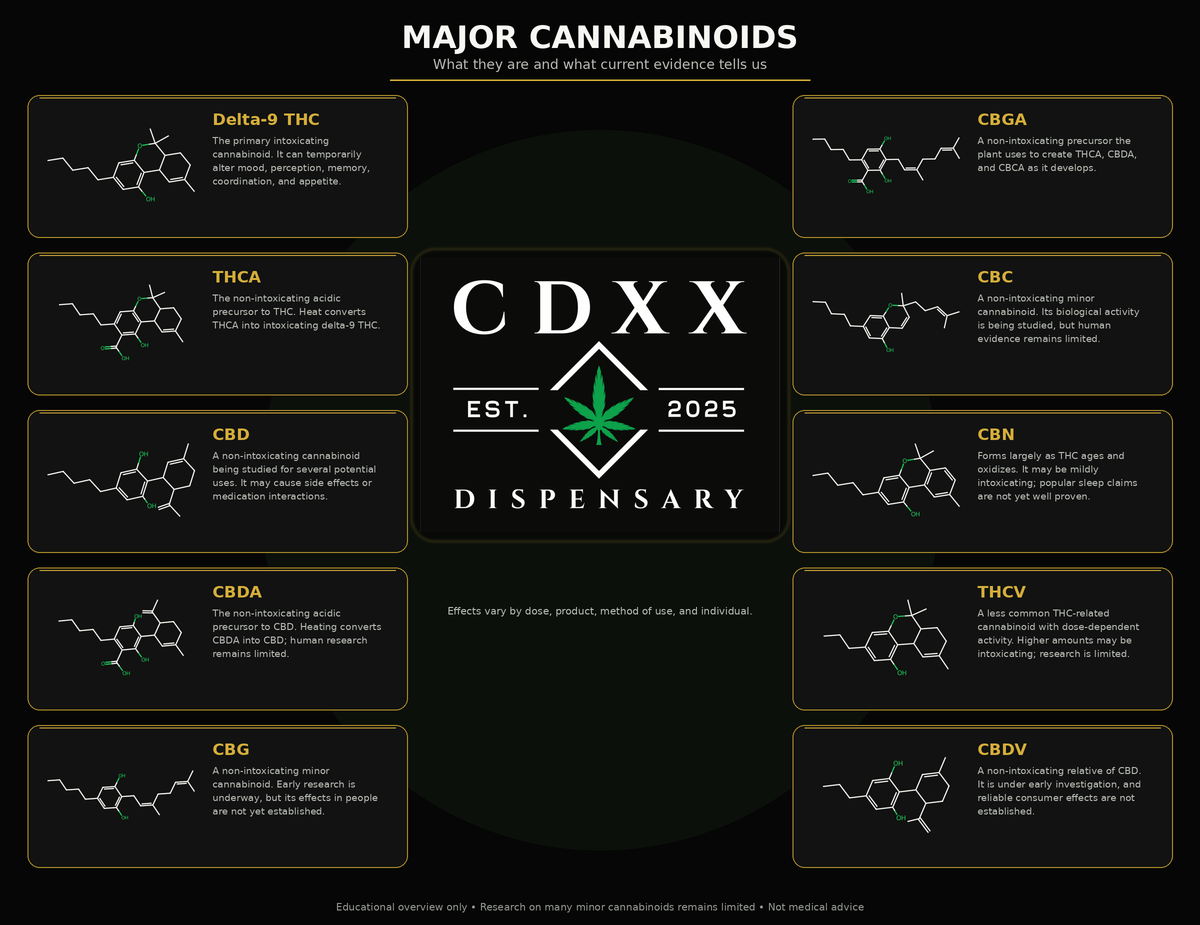
THCA is the acidic precursor to delta-9 THC. It is found naturally in raw and freshly harvested cannabis and does not generally produce the traditional intoxicating effects associated with THC in its unheated form.
When THCA is exposed to heat through smoking, vaping, or dabbing, it undergoes a process called decarboxylation and converts into delta-9 THC. This is why THCA flower and concentrates can become intoxicating when heated.
Although preliminary research has explored THCA’s potential properties, human evidence remains limited.
Delta-9 THC: Tetrahydrocannabinol
Delta-9 THC is the cannabis plant’s primary intoxicating cannabinoid. It binds strongly to CB1 receptors located throughout the brain and central nervous system.
THC may temporarily alter mood, sensory perception, time perception, memory, coordination, and appetite. Depending on the amount consumed and the individual, the experience may include relaxation or euphoria—but higher amounts can also cause anxiety, confusion, paranoia, an elevated heart rate, and impaired coordination.
Products containing THC should never be used before driving or operating machinery.
Delta-8 THC
Delta-8 THC is a naturally occurring cannabinoid related to delta-9 THC, although it is typically present in very small amounts in the plant. Many commercial delta-8 products are produced by chemically converting hemp-derived CBD.
Delta-8 is intoxicating and can impair judgment, reaction time, and coordination. It is sometimes described as producing milder effects than delta-9 THC, but experiences and product strength can vary significantly. Research on delta-8 remains limited, and the FDA has not approved delta-8 products for safe use.
CBD: Cannabidiol
CBD is one of the most widely recognized non-intoxicating cannabinoids. Unlike THC, CBD does not ordinarily produce a traditional “high.”
Researchers continue to study CBD for several possible applications. However, over-the-counter CBD products have not been proven to diagnose, treat, cure, or prevent disease. CBD can also cause side effects and interact with certain medications. The FDA has approved one prescription CBD medication for specific seizure disorders, but that does not mean every retail CBD product has the same medical use or evidence.
CBDA: Cannabidiolic Acid
CBDA is the acidic precursor to CBD and is primarily found in raw cannabis. When heated, CBDA converts into CBD through decarboxylation.
Early laboratory and preclinical research has explored CBDA, but there is not yet enough high-quality human evidence to draw firm conclusions about its effects or potential uses.
CBG: Cannabigerol
CBG is a non-intoxicating minor cannabinoid sometimes called a “mother cannabinoid.” More precisely, its acidic form—CBGA—serves as a chemical starting point from which the plant produces several other cannabinoids.
CBG does not normally create the intoxicating effects associated with THC. Early studies have examined its potential influence on the nervous system, inflammation, appetite, and other biological processes, but clinical research involving people remains limited.
CBGA: Cannabigerolic Acid
CBGA is one of the cannabis plant’s most important precursor compounds. As the plant develops, enzymes convert CBGA into acidic cannabinoids such as THCA, CBDA, and CBCA.
Because much of the plant’s CBGA is transformed into other cannabinoids before harvest, mature cannabis frequently contains only modest amounts. CBGA itself is not considered intoxicating, and research into its effects is still developing.
CBC: Cannabichromene
CBC is another non-intoxicating cannabinoid produced from CBCA. It does not bind strongly to the CB1 receptors responsible for the classic THC high.
Scientists are studying CBC’s interaction with several biological pathways, but human research remains limited. Products containing CBC are frequently marketed as part of broad-spectrum or full-spectrum formulations rather than as high-potency CBC products.
CBN: Cannabinol
CBN is created largely as THC ages and oxidizes. Older cannabis that has been exposed to air, heat, or light may contain higher levels of CBN.
CBN is often promoted as a “sleep cannabinoid,” but evidence supporting that reputation is still limited. Some products combine CBN with THC or other ingredients, making it difficult to determine which compound is responsible for the reported experience. CBN may have mild intoxicating properties, particularly at higher amounts or when combined with THC.
THCV: Tetrahydrocannabivarin
THCV is a less common cannabinoid found in certain cannabis varieties. Although its chemical structure resembles THC, it interacts with cannabinoid receptors differently.
Its effects may depend on the amount consumed, and research into its possible influence on appetite, metabolism, and neurological function is still preliminary. THCV should not be marketed as a proven weight-loss or medical treatment. At higher concentrations, it may produce intoxicating effects.
CBDV: Cannabidivarin
CBDV is a non-intoxicating cannabinoid related to CBD. It appears in higher concentrations in certain cannabis varieties and has attracted research interest for its potential neurological effects.
Most CBDV research remains experimental, and there is not enough evidence to make reliable wellness or medical claims about consumer CBDV products.
What About the “Entourage Effect”?
The entourage effect is the theory that cannabinoids, terpenes, and other cannabis compounds may interact to produce an experience different from that of a single isolated compound.
This concept may help explain why two products with similar THC percentages can feel different. However, the entourage effect is still being studied and should not be treated as a guarantee. Potency, serving size, product quality, individual biology, tolerance, and consumption method can all influence the experience.
Choosing the Right Cannabinoid Product
The highest cannabinoid percentage is not automatically the best choice. When comparing products, consider:
- The cannabinoid profile and laboratory results
- Whether the product may be intoxicating
- The recommended serving size
- Your experience and tolerance
- The consumption method and expected onset time
- The product’s terpene profile
- Possible interactions with medications or health conditions
Begin with a low amount, especially when trying a new cannabinoid or product format. Allow sufficient time for the effects to develop before consuming more. Edibles may take considerably longer to produce noticeable effects than inhaled products.
The CDXX Approach
At CDXX Dispensary, we believe an elevated cannabis experience begins with education. Our knowledgeable budtenders can help you understand cannabinoid profiles, product formats, laboratory reports, and serving information so you can make a more informed selection.
Cannabinoid science continues to evolve, and many minor cannabinoids require significantly more research. Product descriptions should therefore distinguish between established effects, early scientific findings, and customer-reported experiences.
Important: This article is for general educational purposes only and is not medical advice. Cannabis and cannabinoid products can cause side effects, impairment, and medication interactions. Consult a qualified healthcare professional before using cannabinoids for a health-related purpose. Keep all products away from children and pets. For adults 21 and older only.
Sources: National Institute on Drug Abuse—Cannabis and U.S. Food and Drug Administration—Cannabis and Cannabis-Derived Products.